

Pariksha Kahani: Old Raja Saheb was worried. His hair was streaked with silver, and the weight of his years pressed heavily on his shoulders. He was still a capable ruler. However, the time was coming to pass the torch. This was particularly true for the crucial position of his Chief Minister, the Diwan.
A good Diwan wasn’t just smart; he needed a heart, wisdom, and a genuine understanding of his people. How do you truly test for that? Traditional exams, full of facts and figures, felt… inadequate. This wasn’t just about finding intelligence; it was about finding someone embodying the essence of Moral Stories.
So, Raja Saheb came up with a brilliant, unconventional plan. He announced to his kingdom that he was seeking a new Diwan. The selection process would be unique: all candidates were invited to live in the capital for one year. During this time, they wouldn’t face written tests or formal interviews.
Pariksha Kahani: A Powerful Emotional Lesson of Life
Instead, they would simply be in the city, interact with its people, and live their lives. The Raja, he declared, would observe, seeking the kind of innate wisdom often found in the best Lok Kathayein.
The city buzzed with excitement. Ambitious young men and seasoned administrators from all corners of the kingdom flocked to the capital. There were scholars with impressive degrees, strategists who could quote ancient texts, and managers who boasted years of experience. Each one, in their own way, was convinced they had what it took.
They spent their days studying, debating, networking, and trying their best to look impressive and dignified. They were all on their best behavior, acutely aware that the King’s gaze, though unseen, was always upon them. One aspiring Diwan was meticulously researching ancient virtues. He even paused to read the Ajay Ekadashi Ki Kahani. He hoped to internalize its lessons on righteousness.
Months rolled by. The candidates settled into a routine of polite conversations, formal dinners, and quiet study. Many tried to outdo each other in showing their intellect. Others focused on their piety. They always aimed to impress the Raja. They meticulously avoided anything that could be construed as undignified or unbecoming of a future Chief Minister.
Unlike the passionate intensity often found in Romantic Stories, their interactions were coolly calculated. They were driven by ambition rather than genuine connection. One afternoon, a candidate was heard giving an impromptu Akashdeep Kahani Ka Saransh. He spoke to a small, bored audience. This clearly demonstrated his vast knowledge of literature.
Pariksha Kahani: A Bold Heart-Touching Moral Tale
Then came a sweltering afternoon. The air hung heavy. The dust from the roads seemed to cling to everything. A procession of candidates, dressed in their finest silken robes and turbans, were making their way through a narrow lane. They were deep in conversation, perhaps discussing matters of state or philosophy, when their path was blocked. Some candidates had even foregone the excitement of the local Cricket Match that day. They did this to ensure they didn’t miss any opportunity to be seen in the right light.
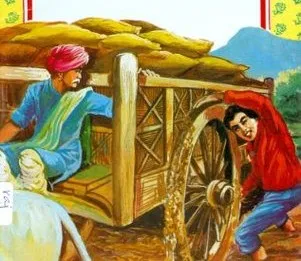
Ahead, an old, rickety bullock cart lay half-submerged in a deep, muddy rut. The single wheel was hopelessly stuck. The old farmer, his face etched with worry and exhaustion, tried futilely to push it out. His bullocks, too, looked tired and overwhelmed. He pleaded for help, his voice raspy and desperate. His plight felt as desolate as a Poos ki Raat, where hardship seems endless.
One by one, the candidates approached the scene. They paused, considered, then, with a dismissive wave or a polite, regretful shake of the head, continued on their way.
“This situation is too simplistic,” one might have thought. It was like a conflict from Kids Stories and certainly beneath a future Chief Minister.
“My clothes would be ruined,” another might have mused, “and what an undignified sight for a potential Diwan!”
Some offered quick, unhelpful advice from a distance. Others chuckled at the old man’s misfortune. They deemed it a common, inconvenient rural scene that had no bearing on their important lives. They maintained their perfect posture. Their garments were pristine. They exuded an air of superiority. They carefully stepped around the mud and the struggling farmer.
Pariksha Kahani: A Gripping Sad Twist in Premchand’s Story
Among these candidates was a young man named Sukhdev Singh. He was known for his sharp mind and his charming demeanor, a true favorite among those who knew him. He was handsome, strong, and carried himself with an innate grace. But as he watched the scene unfold, a prickle of discomfort, then outright empathy, ran through him.
He saw the old man’s despair, the futility of his efforts, and the indifference of the passing crowd. Without a second thought, Sukhdev stopped. He quietly slipped off his expensive outer robe, carefully folded it, and placed it on a clean patch of ground. Then, rolling up his fine sleeves, he walked straight to the cart.
“Let me help you, old father,” he said, his voice kind and reassuring.
The old man looked up, his eyes wide with surprise and a flicker of hope. Sukhdev knelt in the mud, bracing himself against the heavy cart. He called out instructions to the farmer, coordinating their efforts. He grunted and gave a mighty heave.
His muscles strained. Mud splattered his clean white kurta. He pushed with all his might. Slowly, agonizingly, the wheel groaned, the cart lurched, and finally, with a triumphant splash, it broke free from the rut.
Sukhdev was covered in mud, his clothes soiled, his hands dirty. A genuine smile lit up his face. He helped the old man settle his bullocks and cart back on the road.
“Thank you, son,” the old man said, his voice trembling slightly. “May God bless you.”
Pariksha Kahani: A Powerful Positive Turn of Fate
Sukhdev simply nodded, retrieved his robe, and began the walk back, feeling a quiet satisfaction despite his ruined appearance. He didn’t care about the judgmental stares from the other candidates. Some looked back with disdain. Others had a dawning realization.
Suddenly, the old man, who had been watching him, spoke again, but this time his voice wasn’t weak and raspy. It was clear, resonant, and unmistakably regal.
“Sukhdev Singh!”
Sukhdev turned, his jaw dropping. The old farmer’s face, though still weathered, seemed to transform. A familiar, knowing twinkle was in his eyes, and a profound wisdom emanated from his gaze. It was Raja Saheb, his King, in disguise.
The other candidates, who had paused to watch, now stood frozen, their faces paling with shock and regret.
Raja Saheb stepped forward, his eyes fixed on Sukhdev. “My son,” he said, his voice carrying across the lane. “I set out to find a Chief Minister. What I found was more. I found a true leader. A truly great leader isn’t measured by his knowledge or his status. Pariksha Kahani
He is measured by his humility and his compassion. His willingness to dirty his own hands to help those in need also defines him. This is the real test of character, more profound than any dedication shown in Eklavya Ki Kahani.”
He gestured to Sukhdev’s muddy clothes. “These stains,” the Raja declared, “are not blemishes, but badges of honor. You, Sukhdev Singh, possess the heart I was searching for. You will be my new Diwan.”
The other candidates hung their heads in shame. They had spent a year trying to impress a King with their intellect, their debates, and their carefully curated personas. But the King had tested their very humanity, and only Sukhdev, in his selfless act, had passed the true test. Pariksha Kahani
It wasn’t about books or titles; it was about the simple, profound act of helping another soul in distress. And that, Raja Saheb knew, was the true mark of leadership.
Discover more from StoryDunia
Subscribe to get the latest posts sent to your email.