
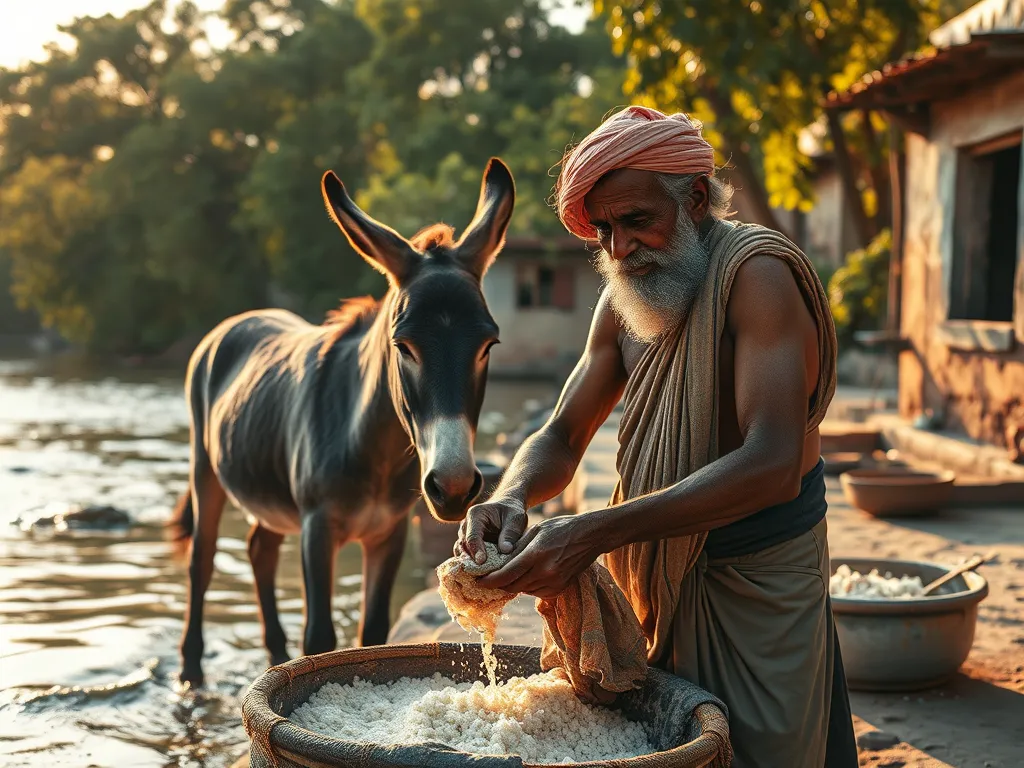

The Panchatantra stories have long been a symbol of ancient Indian wisdom. They offer moral stories that transcend generations. These classic Indian tales often feature animals. They are not merely animal fables. They provide profound life lessons on human nature, ethics, and the consequences of our actions.
Among these cherished narratives, “The Theft of the Donkey,” or “Gadhe Ki Chori,” stands out as a powerful allegory. It explores themes of gullibility, cunning, and the ultimate triumph of justice. It’s a story that compels us to question appearances and remain vigilant against the art of deception.
In a timeless village nestled beside the meandering Yamuna River, a diligent washerman named Dhobiram lived. The scent of freshly laundered clothes mingled with the earthy aroma of the riverbank. His life was one of relentless toil, rising with the sun to shoulder the heavy burdens of his trade.
Every day, Dhobiram would meticulously scrub, rinse, and wring countless garments, his strong hands a testament to his dedication. His sole companion in this arduous journey, and indeed, his most valuable asset, was Moti, a sturdy, grey donkey.
Also Read:- The Deer in the Net: A Tale of Friendship and Deception
The Industrious Washerman and His Faithful Companion
Dhobiram was a man of simple pleasures and an even simpler heart. His world revolved around his small, thatched hut, the river, and his beloved Moti. The donkey, whose name meant “pearl,” was truly a gem in Dhobiram’s eyes. Moti was not just an animal; he was an extension of Dhobiram’s very existence.
From dawn till dusk, Moti would patiently carry enormous bundles of clothes to the river for washing. Then he would transport the clean, damp garments back to the village for drying and delivery. His long ears would swivel. They were always attuned to Dhobiram’s gentle commands. His steady gait never faltered, even under the heaviest loads.
Life for Dhobiram was an endless cycle of labor, yet he found contentment in his honest work. He harbored no grand ambitions, desiring only enough to sustain himself and Moti, who often shared his meager meals. Dhobiram did not see Moti merely as a beast of burden. To him, Moti was a silent and loyal friend. He was an embodiment of tireless dedication.
He often stroked Moti’s rough hide. He whispered words of encouragement and gratitude. Their bond was forged in shared hardship and mutual reliance. The villagers knew Dhobiram as a good, honest soul. He was perhaps a little too trusting. This trait, unbeknownst to him, would soon make him vulnerable to a cunning plot. His innocent nature was also his strength. It was rooted in a belief in the inherent goodness of others. This belief was about to be sorely tested.
Also Read:- The Quarrelsome Women (झगड़ालू स्त्री)
The Shadow of Deception: A Cunning Plan Unfolds
In the same bustling village, Chatura dwelled in the shadows. Ironically, his name meant “clever” or “cunning.” He had meticulously cultivated this reputation through petty thefts. He also engaged in elaborate schemes. Chatura was not a man of muscle but of manipulative intellect.
He preferred to outwit rather than overpower, to exploit the vulnerabilities of others rather than confront them directly. His eyes were always darting and observant. They often settled upon Dhobiram and Moti. He noted the washerman’s unwavering reliance on his donkey.
Chatura understood the economics of the village. A donkey was a vital lifeline for a washerman. Replacing it would be almost impossible without significant financial strain. Stealing Moti would be a lucrative venture. He also sensed Dhobiram’s trusting disposition, a quiet simplicity that made him an ideal target. The thief’s mind, a labyrinth of twisted logic, began to weave a detailed clever trickster plan. He knew that a direct theft might lead to immediate pursuit and suspicion.
No, Chatura decided. This particular act of thievery required a different approach. He wanted to exploit Dhobiram’s faith and simple beliefs and turn his trust into a weapon against him. He planned to employ the highest level of deception. He would disguise himself not as a common rogue. Instead, he’d take on the appearance of a revered figure, a holy man, a guru.
The idea sparked a glint in Chatura’s eyes; it was a challenge worthy of his infamous cunning. He began to practice his expressions. He adopted a serene, otherworldly demeanor. He was ready to cast his spell of lies upon the unsuspecting Dhobiram. The stage was set for a classic tale of cunning thief versus an honest man.
Also Read:- The Story of the Merchant’s Son Read Now
A Web of Lies: The Guru’s Auspicious Advice
One sweltering afternoon, Dhobiram was returning from the river with Moti. They were laden with the day’s washed clothes. At that moment, a figure emerged from the shade of a banyan tree. It was Chatura. He was meticulously disguised as an aged, benevolent sage. He wore saffron robes, a long white beard, and carried a string of prayer beads. His voice, when he spoke, was surprisingly soft yet resonant, imbued with an aura of profound wisdom.
“Greetings, my son,” the ‘sage’ began, his eyes fixed upon Dhobiram with an intensity that seemed to pierce through him. “I have observed your tireless work, your dedication, and your pure heart. But I also sense a profound sadness, a hidden truth that troubles your very existence.”
Dhobiram, startled by the unexpected encounter with such a distinguished-looking holy man, respectfully bowed. “Revered Guru,” he stammered, “I am but a humble washerman. My life is simple, my struggles are apparent, but I know of no hidden sadness beyond the daily grind.”
The ‘guru’ smiled knowingly, a smile that radiated false compassion. “Ah, but the universe holds many secrets, my son. Your loyal companion, this donkey, Moti,” he gestured towards the patient animal, “is not what he appears to be.”
Dhobiram’s eyebrows furrowed in confusion. “Moti? He is my donkey, Guru. My most dependable helper.”
“Indeed,” the ‘sage’ continued, lowering his voice conspiratorially. “But in a past life, Moti was not an animal, but a human! A young prince was full of valor and promise. He was cursed by an enraged celestial being to live as a donkey. This curse would last until a certain celestial alignment.
A specific ritual could break the spell.” Chatura paused, letting his words sink in, watching the mixture of disbelief and awe flicker across Dhobiram’s face. He had carefully crafted this story. He knew Dhobiram’s deep-seated respect for spiritual matters. He also understood his longing for something extraordinary in his mundane life.
“A prince?” Dhobiram whispered, his eyes widening. “My Moti?”
The ‘guru’ nodded gravely. “More than that, my son. Through my deep meditation, I perceive a strong karmic bond. This prince, cursed to be Moti, is none other than your son from a previous birth. He was separated by fate and reunited by destiny. Now he awaits liberation through your devout hands.”
This revelation struck Dhobiram like a bolt of lightning. A son? His son? The yearning for family, for a deeper connection, was something Dhobiram, in his solitary life, had always unconsciously felt. The idea that his faithful donkey was, in fact, a human.
It was his own son, cursed and awaiting his help. This filled him with a potent cocktail of shock, wonder, and a fervent hope that eclipsed all reason. He could barely contain his excitement and nascent paternal affection for Moti.
Seeing Dhobiram’s profound emotional response, Chatura pressed on with the crucial part of his Panchatantra stories deception. “The time for his transformation is nigh. Tonight, under the crescent moon, the alignment will be perfect. You must perform a sacred ritual to break the curse.”
“Tell me, Guru! I will do anything!” Dhobiram pleaded, his voice trembling with emotion.
“Listen carefully,” the ‘sage’ instructed, his voice low and solemn. “You must take Moti to the ancient temple ruins at the edge of the forest, just beyond the village limits. Leave him there overnight. Do not tie him. Let him be free. Then, you must return to your home.
Through the night, you should offer prayers. Perform a fire ceremony and chant sacred mantras. Do not, under any circumstances, look back or return to the ruins until sunrise. By dawn, when you return, Moti will have transformed back into his human form, your son, waiting for you.”
Dhobiram listened, his heart pounding with anticipation. The instructions, though peculiar, were delivered with such conviction and spiritual authority that he dared not question them. The idea of embracing his long-lost son was too powerful to resist. He thanked the ‘guru’ profusely, bowing low, his mind already envisioning the joyful reunion.
That evening, with a mix of trepidation and immense hope, Dhobiram led Moti to the designated spot. He stroked his neck one last time and whispered words of encouragement to his soon-to-be-human son. With unwavering faith, he turned and walked away, not daring to cast a single glance backward.
As the first star twinkled in the darkening sky, Chatura, the cunning thief, emerged from the shadows. He untied the docile Moti and quietly led him away under the cover of the night. Dhobiram was left to his hopeful vigil and a bitter awakening.
Also Read:- The Lion and The Hare: A Tale of Wit and Wisdom from Panchtantra
The Bitter Taste of Betrayal and a Quest for Justice
The night passed agonizingly slowly for Dhobiram. His heart swelled with a mixture of fervent prayer and vivid imagination. He pictured his son, released from the donkey’s form, standing tall and proud, waiting for him at sunrise. The thought filled him with a joy he had never known.
He chanted the mantras the ‘guru’ had taught him. He fueled the small fire while his eyes were fixed on the eastern horizon. He anticipated the first blush of dawn.
The sun began to paint the sky with hues of orange and pink. Dhobiram was weary but exhilarated. He raced towards the temple ruins. His steps were light, his mind alight with hope. He imagined embracing his son, making up for years of lost time.
But as he neared the spot, a cold dread began to seep into his bones. The ruins were silent, desolate. There was no young man, no transformed prince. There was only the empty clearing, the trampled grass where Moti had stood.
His initial joy evaporated, replaced by confusion, then growing alarm. He called out, “Son? Moti?” His voice echoed hauntingly through the stillness. He searched frantically, his heart sinking with each fruitless scan of the area.
As the full light of morning illuminated the stark reality, he realized the crushing weight of betrayal. It descended upon him. There was no curse, no transformation, no son. There was only the brutal fact: his beloved Moti was gone. He had been tricked, robbed not just of his animal, but of his deepest hopes and his trusting nature.
Dhobiram slumped to the ground. Tears welled in his eyes. It was not just for the lost donkey but for the profound humiliation. He also felt the shattering of his simple faith. The ‘guru’ was a fraud, a thief, a master of deception. His livelihood was gone, his companion vanished, and his spirit deeply wounded.
He stumbled back to the village, the weight of his loss heavier than any load Moti had ever carried. He tried to explain the bizarre incident to the villagers, recounting the tale of the ‘guru’ and the cursed prince.
Some listened with pity, others with thinly veiled amusement, shaking their heads at his gullibility. “How could you believe such a tale, Dhobiram?” they asked, their words, though not malicious, stinging him deeply. The whispers followed him: “The washerman lost his mind along with his donkey.”
Dhobiram, however, was not one to wallow in despair for long. Though his heart was heavy, a quiet resolve began to stir within him. He might be simple, but he was not entirely broken. The pain of the betrayal, the loss of Moti, fueled a nascent fire of justice.
He knew in his heart that he had been wronged. Even if no one else believed his fantastic story, he would keep an eye out. He would not forget the face of the ‘guru,’ nor the injustice that had befallen him. He would work harder. He would save what he could. Perhaps, one day, the wheels of karma would turn. His beloved Moti might find his way back. At least, the thief would meet his rightful fate. Dhobiram’s journey for justice served had begun, even if he walked it alone.
Also Read:- The Cunning Jackal (चालाक गीदड़): A Timeless Tale of Wit and Deception from Panchatantra
Karma’s Reversal: The Thief’s Fateful Repetition
Weeks turned into months, and Dhobiram, though still grieving Moti’s loss, slowly rebuilt his life. He rented another donkey when he could afford it, but none could replace the loyal Moti. Meanwhile, Chatura was emboldened by his easy success. He continued his life of deceit. He drifted from village to village, always seeking new marks for his cunning thief strategies. His earlier exploit, the theft of Moti, had been so seamless. It was so devoid of consequence that it became a template for future schemes. He believed he had mastered the art of exploiting simple faith.
One day, Chatura found himself in a neighboring village, observing another washerman, Gopal. Gopal, a man known for his sharp mind and pragmatic approach to life, possessed a sturdy, familiar-looking grey donkey. As Chatura approached the village riverbank, his eyes widened slightly. There, amongst Gopal’s pile of clothes, stood a donkey. And it was unmistakably Moti! His distinctive grey markings and the slight bend in his left ear confirmed it. It was the very animal Chatura had so easily stolen from Dhobiram.
A surge of satisfaction, mixed with a touch of overconfidence, coursed through Chatura. “What a stroke of luck!” he thought. “The donkey is still alive and well. Now I can try my trick again. Perhaps I can sell him for even more this time.” He decided to use the exact same plan, assuming that all washermen were as easily swayed as Dhobiram. He donned his sage disguise once more. He approached Gopal with the same feigned benevolence. He began to spin the familiar yarn of the “cursed donkey.” This story was about a human prince awaiting transformation.
Gopal listened patiently, his keen eyes observing every detail of the ‘guru’s’ performance. He had heard whispers from other villages about a trickster sage and tales of mysteriously vanishing donkeys. As the ‘guru’ wove his fantastical tale, Gopal’s sharp mind instantly recognized the pattern. The tale was about the prince trapped in a donkey’s body. Gopal’s sharp mind instantly recognized the pattern. The Panchatantra stories’ cunning was at play. He distinctly remembered Dhobiram’s tragic story. The description of Dhobiram’s stolen donkey perfectly matched the animal standing before him now. It clicked. This was Dhobiram’s Moti, and this ‘guru’ was the thief!
Rather than confronting the thief directly, Gopal, a man of critical thinking, decided to play along. He feigned earnest belief, his face mirroring the same hope and wonder Dhobiram had once displayed. “Oh, revered Guru!” he exclaimed, “I am so blessed to have met you! I will follow your instructions to the letter!”
Chatura, basking in what he believed was another easy conquest, beamed. He repeated the ritual instructions. He emphasized the need to leave the donkey at a secluded spot near the old banyan tree. Prayers had to be performed elsewhere through the night. He promised a human son by morning. Gopal nodded solemnly, agreeing to everything. However, as soon as the ‘guru’ departed, Gopal wasted no time. He gathered a few trusted villagers. He recounted the strange encounter. Gopal expressed his strong suspicion that this was the notorious donkey thief. Together, they formulated a plan. They would hide near the banyan tree that night, ready to spring their trap.
As the moon climbed high, casting long, eerie shadows, Gopal led Moti to the designated spot. He made a show of leaving the donkey and then retreated, but not to pray. Instead, he joined the hidden villagers, their hearts pounding in anticipation. As expected, Chatura crept stealthily under the cloak of darkness. The clever trickster moved towards the banyan tree. He was eager to reclaim his ‘transformed’ prize. As he reached out to untie Moti, a shout pierced the night. “Caught you, you wretched thief!”
Before he could react, Gopal and the villagers sprang from their hiding places, surrounding him. Chatura, completely flustered and caught off guard, stood frozen, his elaborate disguise suddenly appearing ridiculous. The villagers quickly disarmed him and bound him, recognizing the ‘sage’ for the cunning thief he truly was. The karma he had so cleverly evaded for so long had finally caught up with him.
Also Read:- The Foolish Sage and Swindler Read Now
Wisdom Gained: Lessons from the Stolen Donkey
The following morning, word spread like wildfire throughout the region. Chatura, the notorious trickster who had plagued several villages with his elaborate schemes, had finally been apprehended. Gopal, the astute washerman, became an instant hero. When Dhobiram heard the news, a flicker of hope ignited within him. He rushed to Gopal’s village, his heart pounding. And there, standing patiently beside Gopal, was Moti! Dhobiram’s eyes welled up with tears of joy and relief as he recognized his faithful companion. The reunion was emotional, a testament to the strong bond between man and animal.
Dhobiram quickly corroborated Gopal’s story. He confirmed Chatura’s identity and recounted the full extent of the deception he had endured months ago. The villagers, who had once dismissed Dhobiram’s tale, now listened with awe and regret. Chatura was handed over to the authorities, his career as a cunning thief brought to an ignominious end. The donkey, Moti, was joyfully returned to Dhobiram. This event signified not just the recovery of a lost asset. It also marked the restoration of justice and faith.
The tale of “The Theft of the Donkey” became a powerful moral story for everyone. It taught invaluable life lessons about the dangers of blind faith and the crucial importance of critical thinking. The villagers realized that while faith in the divine is commendable, gullibility in worldly matters can lead to profound loss. It emphasized that true wisdom lies not in accepting every miraculous claim. Instead, true wisdom lies in questioning, verifying, and trusting one’s own instincts. This is especially important when confronted with seemingly too-good-to-be-true propositions.
The story reinforced the universal truth that greed often leads to one’s own downfall. Chatura’s overconfidence led to his undoing. His decision to repeat the same trick, rather than devising a new one, was a mistake. Karma, as the villagers noted, has a peculiar way of ensuring justice. It eventually catches up with those who sow seeds of deceit. This Panchatantra story remains a timeless reminder. Cunning and deception might offer temporary gains. However, honesty, vigilance, and the pursuit of truth will always prevail in the end. It’s a testament to the enduring ancient Indian wisdom. This wisdom continues to enlighten and guide us through the complexities of human interaction.
Discover more from StoryDunia
Subscribe to get the latest posts sent to your email.