
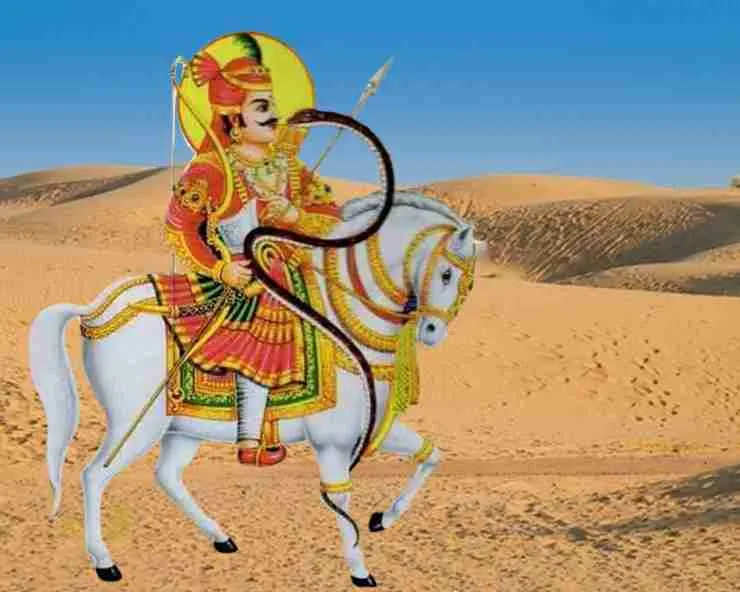

Rajasthan is steeped in heroic tales and vibrant traditions. In its heart, there is the enduring legend of Tejaji Maharaj. This legend lies in a place filled with colorful customs. More than just a folk hero, Tejaji is revered as a deity. He is seen as a guardian of cattle and a symbol of ultimate sacrifice for the sake of a promise. His story, passed down through generations, paints a vivid picture of a courageous farmer. This farmer became immortal through his unwavering commitment to truth. He is also remembered for his dedication to the welfare of his community.
The Birth of a Legend in Kharnal: Tejaji’s Early Life and Noble Roots
Our tale begins in the ancient village of Kharnal (Karnal), nestled in the Nagaur district of Rajasthan, around the 11th century (often cited as 1074 AD). Here, to the respected Dhobiya Jat family of Taharji and Sugna Devi, a son was born, destined to etch his name into the annals of history – Teja. From a tender age, Teja displayed extraordinary qualities. He was not just a robust and skilled young man, but possessed a profound sense of justice, a compassionate heart, and an innate connection to the earth and its creatures. His upbringing instilled in him the values of hard work, honesty, and self-reliance, traits that would define his legendary journey.
Kharnal, during those times, was a thriving agricultural community. Teja grew up amidst the fields, learning the rhythms of nature and the importance of livestock. He was known for his exceptional horsemanship, a skill that would later become synonymous with his image. His loyal mare, Lilan, a magnificent white horse, was not merely a companion but an extension of his spirit, swift and faithful, understanding his every command. This deep bond between Teja and Lilan is a poignant thread throughout the narrative, symbolizing loyalty and mutual respect.
A Preordained Union: The Story of Teja and Pema Devi
As was customary in those times, Teja’s marriage was arranged by his parents at a young age. His destined bride was Pema Devi (also known as Perma Devi or Pemal Devi), the daughter of Raymalji from the village of Pander. However, fate had a twist in store for this union. Due to a misunderstanding between Teja’s mother and Pema’s aunt (or mother, depending on the version of the story), Teja’s family had not brought Pema Devi home after the wedding rituals. Years passed, and Pema remained at her parental home, patiently awaiting her husband.
This separation created a silent void, a forgotten promise in the humdrum of daily life. Teja, engrossed in his farming duties, remained unaware of the full circumstances. The human element of this story shines through here – the everyday family dynamics, the minor disputes that can lead to unintended consequences.
The Catalyst: A Bitter Gourd and a Mother’s Words
The pivotal moment that set Teja’s extraordinary journey in motion was a seemingly trivial domestic incident. One day, while Teja was working tirelessly in the fields, his mother sent food for him. Upon tasting a dish of bitter gourds, Teja expressed his displeasure. His mother, perhaps exasperated, retorted sharply, “Why don’t you go to your in-laws’ house? There, your wife will cook dishes to your liking!”
These words, though spoken in anger and without malicious intent, struck Teja deeply. He was not just hurt by the criticism of his farming efforts but also by the realization that his wife, Pema, was still at her parental home, a situation he had perhaps overlooked or been kept ignorant of. It was a wake-up call, igniting a sense of duty and responsibility within him. He felt a profound obligation to retrieve his wife and rectify the long-standing oversight.
The Journey to Pander: A Test of Resolve
With a resolute heart, Teja decided to embark on the journey to Pander. He prepared his faithful mare, Lilan, saddling her for the long ride. His mother, seeing his determined resolve, tried to dissuade him, citing ill omens and the dangers of the journey. But Teja, a man of strong will, was undeterred. He believed in confronting his duties head-on.
His ride to Pander was not just a physical journey but an emotional one. He traversed the arid landscapes of Rajasthan, the sun beating down, the dust rising with Lilan’s hooves. Along the way, he encountered various people, some offering warnings, others expressing admiration for his determination. The journey itself symbolized the path a hero often takes – solitary, fraught with challenges, yet propelled by an inner moral compass.
The Unforeseen Encounter: A Promise to the Naagraj
As Teja rode through a dense jungle, he came across a startling sight. A massive, enraged snake, a Naagraj (King of Snakes), was trapped in a burning bush, its fiery home. The snake, furious and in immense pain, was about to strike at Teja, believing him to be an intruder.
Teja, with his characteristic compassion and courage, halted. He did not fear the serpent but understood its plight. He pleaded with the Naagraj, explaining his urgent quest to bring his wife home. He made a solemn promise: he would first complete his duty, rescue the stolen cattle from the Mer raiders, and then return to allow the snake to bite him. The snake, initially skeptical and filled with vengeance, was moved by Teja’s earnestness and his unwavering commitment to his word. It recognized a rare purity of spirit. It agreed, but with a condition: Teja must return, no matter what.
This encounter is the linchpin of the entire legend. It establishes Teja’s defining characteristic: his absolute adherence to a promise, even when faced with death. It also introduces the supernatural element, elevating Teja from a mere mortal to someone interacting with divine (or semi-divine) beings.
Arrival at Pander and the Plea for Help
Upon reaching Pander, Teja was finally reunited with Pema Devi. Their reunion was tinged with the awkwardness of a long-separated couple and the urgency of Teja’s purpose. However, their joy was short-lived. The village of Pander was in despair. During Teja’s journey, the notorious Mer raiders, fierce and formidable tribesmen, had attacked the village and stolen a large herd of its prized cattle. The villagers were helpless, their livelihoods plundered.
Teja, witnessing the distress of his in-laws and the entire community, immediately felt a surge of righteous anger. He could not stand by while injustice prevailed. He was a protector by nature, and the sight of suffering cattle, which he held in high regard, spurred him into action. Despite having just arrived and still needing to fulfill his promise to the Naagraj, his immediate duty was clear: protect the innocent and retrieve what was stolen.
The Fierce Battle and the Rescue of Cattle
Without hesitation, Teja mounted Lilan, his sword flashing in the sun. He rode off in pursuit of the Mer raiders, his heart burning with courage. Lilan, sensing the urgency and the righteous cause, galloped with unprecedented speed.
The battle that ensued was fierce and bloody. Teja, a skilled warrior, fought with unparalleled valor against the formidable raiders. He was outnumbered, but his determination was unwavering. His sword, wielded with expert precision, cut through the ranks of the raiders. Lilan, too, played her part, dodging blows and carrying Teja swiftly through the fray.
After a protracted and arduous fight, Teja emerged victorious. He single-handedly defeated the raiders, retrieved all the stolen cattle, and scattered the remaining bandits. He suffered numerous wounds in the process, his body bleeding and bruised, but his spirit remained unbroken. The villagers of Pander rejoiced, showering him with praise and gratitude. He had not only brought their cattle back but had also restored their honor and faith.
The Return and the Ultimate Sacrifice: Fulfilling the Promise
Despite his severe injuries and the exhaustion from the battle, Teja did not forget his promise to the Naagraj. As the sun began to set, casting long shadows across the land, he turned Lilan back towards the jungle where he had encountered the snake. The villagers, bewildered by his decision to leave so soon and in such a state, tried to stop him, urging him to rest and heal. But Teja, a man of his word, knew his duty.
He found the Naagraj patiently waiting, its form now calm but expectant. The snake reminded him of his promise. Teja, with humility and dignity, presented himself. However, there was a dilemma. His entire body was covered in wounds and blood from the battle. The snake declared that it could not bite him on any already wounded or bloody part of his body, as that would not be a true fulfillment of the promise.
Teja, ever ingenious and resolute, thought for a moment. He extended his tongue, the only unblemished part of his body. The Naagraj, witnessing this extraordinary display of unwavering truthfulness and courage, was deeply moved. With reverence, it bit Teja on his tongue.
The venom spread rapidly through Teja’s body. As life ebbed away from him, he remained calm, his eyes fixed on the horizon. He had fulfilled his promise, protected the innocent, and upheld the highest ideals of truth. As he breathed his last, his spirit is said to have ascended to the heavens, leaving behind a legacy that would forever inspire.
Lilan’s Lament and the Revelation of Divinity
Lilan, his faithful mare, sensing the loss of her beloved master, galloped back to Pander, her eyes filled with tears, her whinny a mournful cry. Her return without Teja brought sorrow and despair to Pema Devi and the villagers. They quickly understood the tragic sacrifice Teja had made.
News of Teja’s valor and his ultimate sacrifice spread like wildfire. The villagers, realizing the immense spiritual power behind his actions, began to revere him. Temples were erected in his honor, and he was elevated to the status of a folk deity – Tejaji Maharaj.
The Legacy of Tejaji Maharaj: A Symbol of Faith and Protection
Tejaji Maharaj’s legend is not just a historical account; it’s a living tradition that continues to shape the cultural and spiritual landscape of Rajasthan and beyond.
- Guardian of Cattle (Pashudhan Rakshak): Tejaji is primarily worshipped as the protector of cattle. Farmers pray to him for the health and safety of their livestock, crucial for their livelihood.
- Healer of Snake Bites (Sarp-Rakshak): Due to his encounter with the Naagraj, Tejaji is also believed to have the power to cure snake bites. Devotees often visit his temples or invoke his name for protection against venomous creatures.
- Symbol of Truth and Commitment (Vachanbaddh): His story is a powerful testament to the sanctity of a promise. His willingness to sacrifice his life for his word serves as an eternal lesson in integrity and honesty.
- Courage and Selflessness: Tejaji’s bravery in facing the raiders and his selflessness in protecting the community are inspirational.
- Tejaji Dashmi: The most significant celebration associated with Tejaji Maharaj is Tejaji Dashmi, observed on the tenth day of the bright half of the lunar month of Bhadrapada (Bhadrapada Shukla Dashmi). This day is marked by grand fairs, processions, and fervent worship at his temples, especially in Kharnal, Sursura (where he is believed to have died), and Pander. Farmers bring their cattle, and people from all walks of life gather to pay homage to the great hero. Traditional folk songs (Tejaji ke Geet) and dances are performed, recounting his epic tale.
Temples and Pilgrimage Sites:
- Kharnal, Nagaur: His birthplace, a primary pilgrimage site.
- Sursura, Ajmer: Believed to be the place where he attained samadhi (died).
- Pander, Ajmer: His in-laws’ village, also home to a significant temple.
- Numerous other temples dedicated to Tejaji Maharaj can be found across Rajasthan and neighboring states.
Beyond the Legend: The Human Connection
While Tejaji Maharaj is revered as a deity, the human aspects of his story are what make him so relatable. His anger at his mother’s words, his sense of duty towards his wife, his compassion for the snake, his fierce protectiveness of the cattle – these are all deeply human emotions and motivations. He was a farmer, a husband, a son, a warrior – a man of the people who, through extraordinary circumstances and an unwavering moral compass, transcended his mortal existence.
His legend serves as a moral anchor in a world often challenged by broken promises and fading integrity. It reminds us that true heroism lies not just in mighty deeds, but in the steadfast adherence to one’s word and the selfless protection of the vulnerable. Tejaji Maharaj lives on, not merely in stone idols, but in the hearts of millions who seek inspiration from his timeless saga of truth, valor, and divine sacrifice.
FAQs
Ques: Who was Tejaji Maharaj?
Ans: Tejaji Maharaj was a legendary folk hero and revered deity from Rajasthan, India, believed to have lived in the 11th century. He is celebrated for his unwavering commitment to truth, his immense courage, and his ultimate sacrifice to keep a promise. He is often worshipped as the protector of cattle and a healer of snake bites.
Ques: Where was Tejaji Maharaj born?
Ans: Tejaji Maharaj was born in the village of Kharnal (Karnal) in the Nagaur district of Rajasthan, India.
Ques: What is Tejaji Maharaj famous for?
Ans: Tejaji Maharaj is famous for several key aspects:
* His absolute adherence to a promise, even at the cost of his life.
* His bravery in single-handedly rescuing stolen cattle from Mer raiders.
* His connection with snakes, and his ability to cure snake bites (post-mortem legend).
* His loyal mare, Lilan, who is almost as famous as him.
* Being a revered deity for farmers, particularly as a protector of livestock.
Ques: How did Tejaji Maharaj die?
Ans: Tejaji Maharaj died after being bitten on his tongue by a snake (Naagraj). He had made a promise to the snake that he would return to allow it to bite him after he had fulfilled his duty of rescuing stolen cattle. After a fierce battle where his body was covered in wounds, he offered his unblemished tongue to the snake to keep his word.
Ques: What is Tejaji Dashmi?
Ans: Tejaji Dashmi is an important Hindu festival. The festival is celebrated annually. It occurs on the tenth day of the bright half of the lunar month of Bhadrapada (Bhadrapada Shukla Dashmi). It commemorates the sacrifice and legacy of Tejaji Maharaj. Devotees visit his temples and offer prayers. Large fairs are organized, especially in Rajasthan. These fairs feature folk music, dance, and cattle trading.
Ques: Which animal is associated with Tejaji Maharaj?
Ans: Two animals are strongly associated with Tejaji Maharaj:
* The Horse (Lilan): His loyal white mare, Lilan, was his constant companion and played a significant role in his legend, particularly in the battle and the sorrowful return after his death.
* The Snake (Naagraj): His promise to a powerful snake and his subsequent sacrifice by allowing the snake to bite him are central to his story and worship.
Ques: Is Tejaji Maharaj considered a God?
Ans: Yes, Tejaji Maharaj is widely revered as a folk deity or a local god in Rajasthan and surrounding regions. He is worshipped by millions, particularly farmers and rural communities, who consider him a divine protector and intercessor.
Ques: What are the main teachings or values from Tejaji Maharaj’s story?
Ans: The story of Tejaji Maharaj embodies several profound values. He exemplifies truth and integrity (Vachanbaddh). Keeping one’s word is paramount, even at the cost of one’s life.
* Courage and Valor: His fearless fight against injustice and raiders.
* Compassion: His initial interaction with the snake and his concern for the suffering villagers.
* Duty and Responsibility: His unwavering commitment to protect his community and livestock.
* Selflessness and Sacrifice: His ultimate act of giving his life for a noble cause.
Check the Latest Updates Here
Discover more from StoryDunia
Subscribe to get the latest posts sent to your email.