
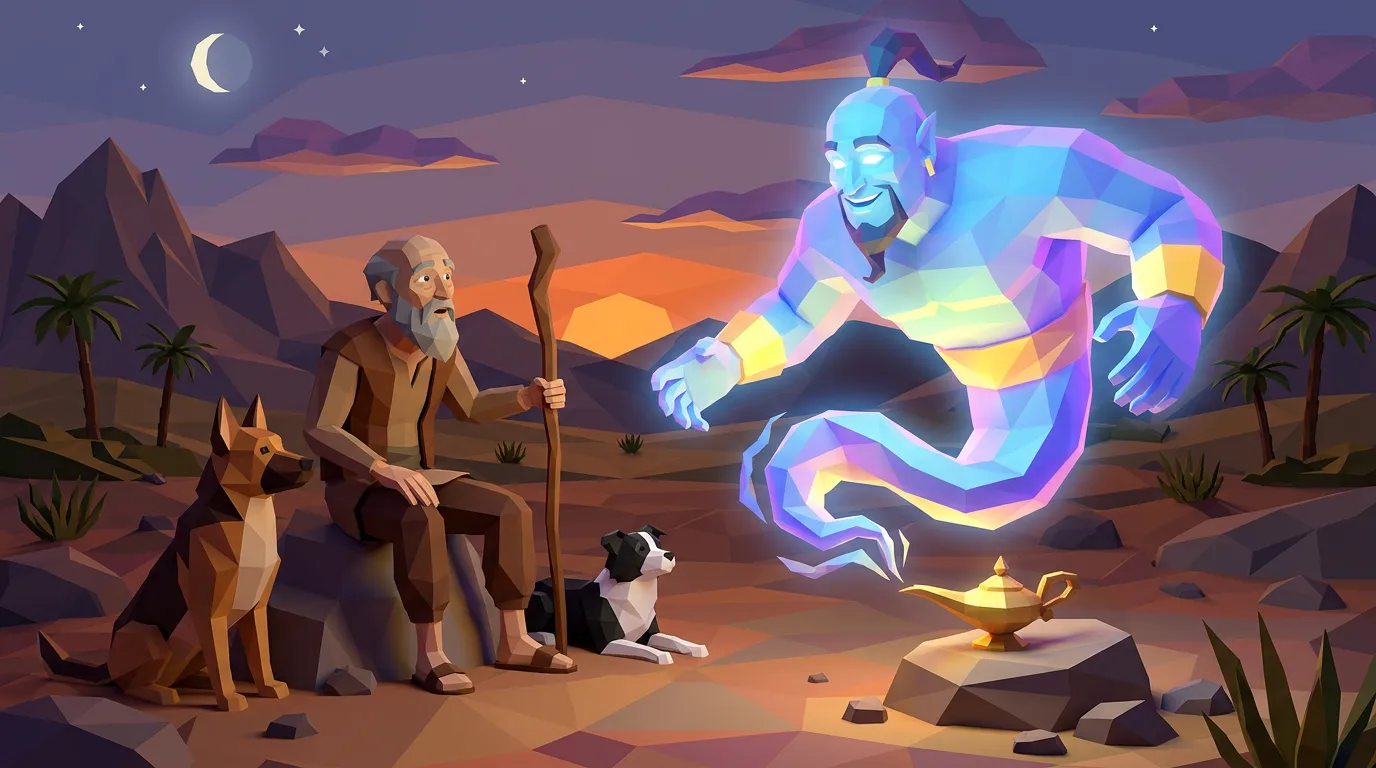

In the heart of the desert, beneath the shadow of the merchant’s despair, the second old man stepped forward with his two black hounds. The air was thick with the scent of ancient magic and the lingering fear of the Jinni’s wrath. Much like the complex narratives found in The Porter and Three Ladies, this story begins with a bond of blood that was eventually poisoned by the green-eyed monster of envy.
The Three Brothers and the Call of Trade
I was once one of three brothers. When our father passed away, he left us a considerable fortune. Each of us received a thousand sequins. I decided to open a shop and live a life of steady trade. However, my two elder brothers were restless. They squandered their inheritance on lavish travels and returned to me in rags, begging for assistance. Unlike the tragic figures in The Vizier’s Son, I did not turn them away. I shared my profits and helped them rebuild their lives, not once, but twice.
Eventually, they persuaded me to join them on a maritime trading expedition. We set sail with a ship full of merchandise, hoping for prosperity. It was during this journey that I encountered a woman of extraordinary grace but dressed in humble tatters. She begged me to take her as my wife, promising that she would be a faithful companion. I felt a deep sense of compassion, a virtue often tested in The Tale of the Young King, and I married her on the spot.
Betrayal on the High Seas
As we sailed back, my brothers’ hearts grew dark. They saw my success and my beautiful wife, and their jealousy became a living thing. One night, while I slept beside my bride, they crept into our cabin and threw us both into the churning depths of the ocean. They believed I was dead, and that my fortune was finally theirs to claim.
But my wife was no ordinary woman. As I hit the water, she transformed into a powerful fairy. She caught me in her arms and carried me to a safe island. She revealed that she was a spirit of the air who had fallen in love with my kindness. Her power was immense, reminiscent of the enchantments found in The Lady of the Glass Jar.
The Transformation and the Dogs
In her fury, the fairy wanted to destroy my brothers. “They have broken the sacred bond of brotherhood,” she cried. But I pleaded for their lives. I could not bear to have their blood on my hands. Touched by my mercy, she chose a different path of justice. She flew to our ship, transported my brothers back to my home, and with a flick of her wrist and a whispered incantation, she transformed them into these two black dogs you see before you.
“They must remain in this form for ten years,” she decreed. “Only then can their penance be considered complete.” I have traveled with them ever since, seeking a way to redeem their souls. This curse of transformation is a heavy burden, much like the one witnessed in The Third Old Man and Mule, where the line between beast and man is blurred by magic.
The Moral of the Tale
The Jinni listened to the second old man’s story with growing interest. The tale of mercy in the face of absolute betrayal was a rarity even in the world of spirits. The two dogs looked up at the Jinni with pleading eyes, their tails tucked between their legs—a silent testament to a decade of regret. Through this narrative, we learn that while envy can destroy a family, mercy is the only force capable of sustaining a soul through the darkest of times.
Recommended Reads
- Moral Story: Lessons for Every Generation
- Horror Story: Chilling Tales from the Dark
- Munshi Premchand: Classics of Indian Literature
- Panchtantra: Ancient Fables of Wisdom
Discover more from StoryDunia
Subscribe to get the latest posts sent to your email.