
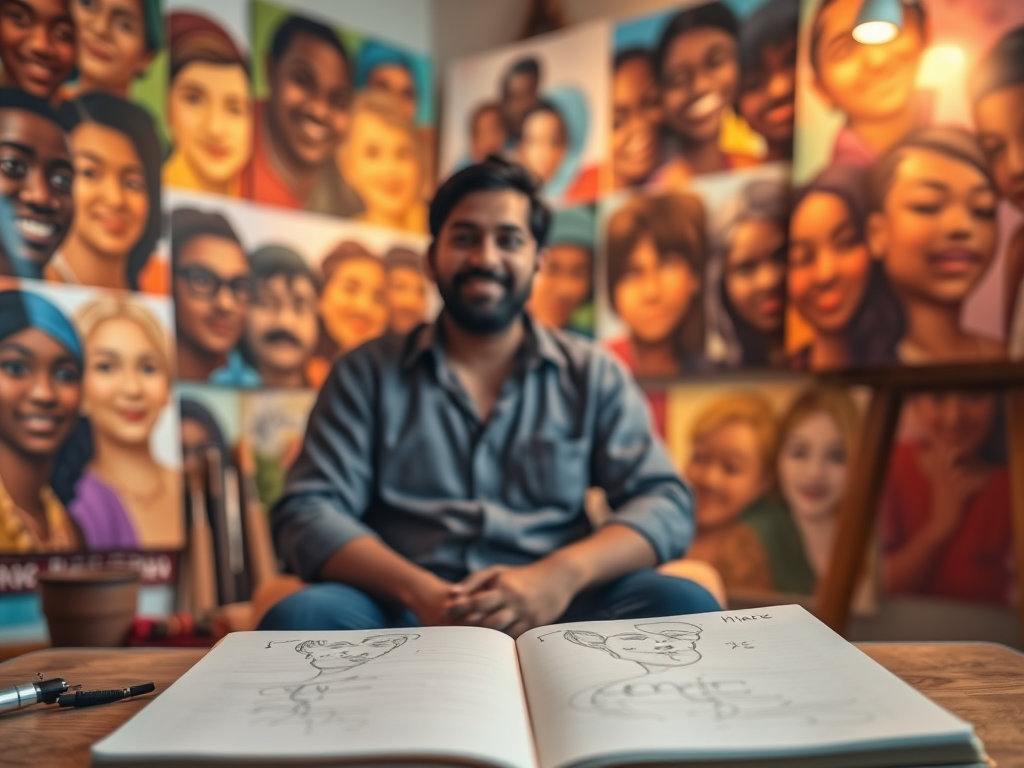

The Art of Connection: In a bustling city that never truly slept, every second person seemed lost in their phones. Earbuds drowned out street sounds. There lived a man named Arjun. He was an artist—not just by profession but by soul. His small studio, nestled between a forgotten library and a tea stall, was a world of colors, chaos, and curiosity.
But Arjun wasn’t famous. He wasn’t viral. He didn’t paint for galleries or high-end buyers. He painted people—their expressions, their silences, their overlooked beauty. His favorite canvas wasn’t the one stretched tight on wooden frames. It was the faces of strangers.
He often sat in cafes sketching people in quiet corners. Sometimes, he’d leave the sketches behind, unsigned, for them to find. Sometimes, he’d walk up and say, “I saw a story in your smile. Would you like to see it in colors?”
Also Read: मीना मंच की प्रेरणादायक कहानी, Meena Manch Ki Kahani
It was his way of connecting—wordless but deep. He believed connection wasn’t about conversation. It was about presence. And presence, sadly, was becoming a dying art.
The Art of Connection: More Than Just Conversation
One rainy evening, as the world outside blurred with monsoon mist, a girl entered his studio. She looked lost—not in direction, but in purpose.
“I was told you paint strangers,” she said, her voice carrying a strange mix of confidence and exhaustion.
“I do,” Arjun smiled. “But you don’t feel like one.”
Her name was Meera. A storyteller by job title, but a silent one in life. She wrote ads, catchy slogans, and sometimes fake testimonials. She used to write poems once—but that was before deadlines, briefs, and client feedback robbed her words of soul.
“I’ve forgotten how to connect,” she confessed as Arjun handed her a cup of chai. “I talk to a thousand people online but I can’t remember the last time I had a real conversation.”
Arjun didn’t offer advice. He handed her a sketchbook. “Draw. Write. Scribble. Whatever. Just… be here.”
Also Read: Chalak Lomdi ki Kahani Read Full Story Now
And she kept coming. Every evening, she’d sit quietly. Sometimes she drew clouds that looked like cotton candy. Other times she scribbled poems that made no sense but felt like freedom. Slowly, her smile returned. Not the Instagram kind. The real kind—the one that stayed even when no one was watching.
Their bond deepened, not through long chats but through shared silences. Meera taught Arjun to laugh louder. Arjun taught Meera to see beauty in broken things.
The Art of Connection: Finding Healing in Being Seen
One day, she brought him an old diary—her childhood one. Pages filled with wide-eyed dreams and innocent poems.
“Do you think connection can heal?” she asked, flipping through faded memories.
“I think connection is healing,” Arjun replied. “When you feel seen—really seen—it changes you.”
The Art of Connection: A Space for Unfiltered Expression
Inspired, they started a project called The Art of Connection.
They invited people—strangers, loners, dreamers, wanderers—to their studio on weekends. There were no fees. No agenda. Just a white wall, markers, and music. People came and painted emotions—grief, joy, heartbreak, hope. Some sang. Some cried. Some just watched.
One man, who hadn’t spoken a word since his wife died, came every week and painted blue waves. He never said why, but everyone felt the depth in his silence.
A teenage girl painted butterflies with broken wings and whispered, “I don’t want to be fixed. Just understood.”
A cab driver painted traffic—messy, chaotic, colorful. “This is my peace,” he smiled. “It’s strange, isn’t it?”
It became a movement—quiet, organic, soulful. Not trending. Not monetized. But real.
One evening, Arjun wasn’t in the studio. Meera found a letter on his easel:
“Sometimes, to connect deeper, we need to disconnect first. I’m going away for a while—into the hills, into myself. Keep the studio alive. Keep the stories breathing.”
Also Read: True Friendship Story for Kids, Read Now
She waited. A week. A month. No call. No message. The absence felt loud. But she respected it. Arjun always said silence had a language too.
She continued the project. Alone at first. But slowly, others stepped in. Volunteers, dreamers, people Arjun had once touched without knowing. They painted. They wrote. They hugged. They healed.
After six months, Arjun returned—his beard longer, eyes calmer.
Meera stood at the door, arms crossed, mock angry. “You vanished.”
“I connected—with myself,” he smiled.
And she hugged him—because no words could fill the space silence already had.
The Art of Connection: A Legacy of Presence
Years passed. The Art of Connection grew. Schools invited them. Offices asked for workshops. Prisons, rehab centers, even weddings—everyone wanted a taste of what they’d created. A space where no one judged. Where masks came off.
But they never turned it into a brand. They refused sponsors, logos, and ad deals.
“We’re not selling healing,” Arjun would say. “We’re sharing it.”
One day, an old man walked in. Bent back, trembling hands, watery eyes.
“I used to be a writer,” he said. “Then life got busy. I forgot how words felt.”
They gave him a chair, a pen, and quiet.
He came every week. Wrote letters—to himself, to his late wife, to the child he once was.
On his last visit, he said, “I didn’t come here to remember. I came here to feel again. Thank you.”
He passed away two months later. His daughter sent them a note:
“In his last days, he kept saying—I found connection again. I found myself. You gave him that.”
The Art of Connection wasn’t about art anymore. It was about people. Raw, real, unfiltered.
It taught everyone that connection wasn’t a luxury. It was a necessity.
That a simple “How are you, really?” could change someone’s day.
That sitting in silence with someone hurting was more powerful than a thousand quotes.
That when we remove the noise, we find each other.
In today’s world of likes and followers, Meera often said, “You know what’s rare? Being heard without interruption.”
Also Read: Beyond The Obstacle Kabir’s Transformative Journey
And Arjun would add, “Or being seen without performance.”
They never expanded. They never franchised. But they inspired a hundred similar spaces across cities. Little studios. Cafes. Corners. Safe places where people came not to impress, but to express.
And on the studio wall, they painted a simple line in bold colors:
“In a world full of connections, be someone who truly connects.”
Moral:
The art of connection isn’t in being perfect. It’s in being present.
It’s not about fixing people. It’s about feeling with them.
It’s not in the noise of attention. It’s in the quiet of understanding.
And sometimes, the most profound connection starts with a simple act: showing up—with your full heart.
Discover more from StoryDunia
Subscribe to get the latest posts sent to your email.
You must be logged in to post a comment.